Coin Emission-Rate Modulation
Main
"Coin Emission-Rate Modulation" (CERM) reflects the fact that this algorithm adjusts the rate of coin emission without changing the total emission limit.
Modulation is a modifying or controlling influence on something.
CERM Algorithm
Bitmark’s Coin Emission-Rate Modulation algorithm, version 1.0 (CERM v1), affects block rewards by scaling a portion of the epoch reward by a factor obtained by dividing the current hash rate by the peak hash rate. This factor is defined as the Emission Scaling Factor (ESF).
ESF = current_hashrate / peak_hashrate
Block Rewards Adjustment
Block rewards are either the complete standard or nominal amount for the epoch, or are reduced (modulated) according to the ratio of present network hashrate compared to the preceding year’s peak hashrate.
On a daily basis, defined as every 720 blocks, the algorithm identifies the highest hash rate from the past year (365 days) and uses it as the peak hash rate.
Visualizations & Resources
Bitmark
- Animated block reward schedule: cumulative bitmarks mined from July 2014 into the future, through the alternating quarterings and halvings.
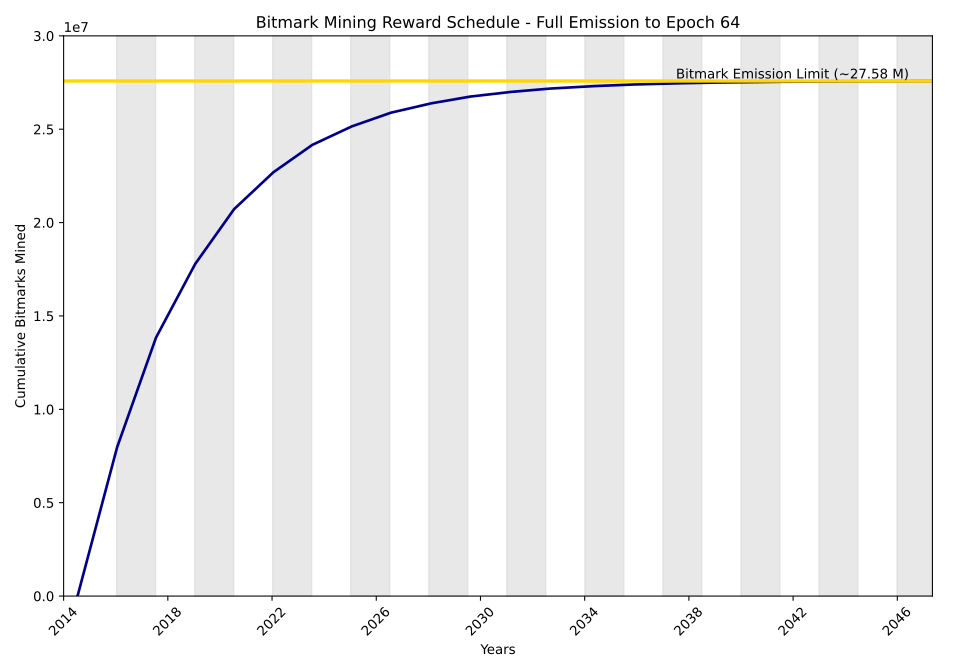
- Full emission schedule: the theoretical cumulative emission curve under the nominal quartering and halving schedule, approaching the ~27.58 M BTMK limit.
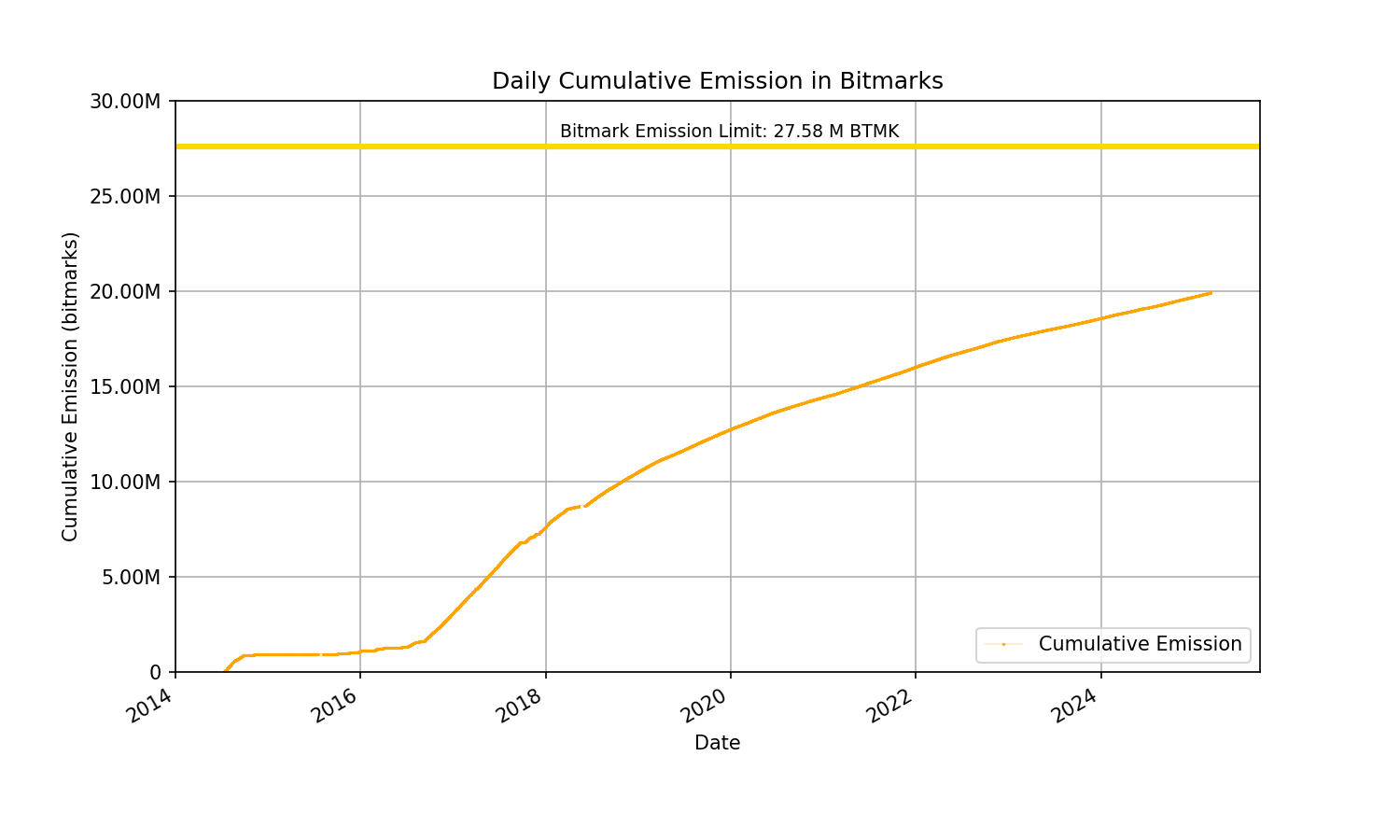
- Daily cumulative emission chart: the chart shown above, at full size.
- Emission limit calculator (C source): computes the per-epoch reward, epoch emission and cumulative emission (20 BTMK at genesis, 394,200 blocks per epoch).
Bitcoin, for comparison
- Animated Bitcoin reward schedule: cumulative bitcoins mined under the halving schedule, from 2009 into the future.
- Bitcoin reward schedule plot: a static chart of the same schedule.
- Interactive Bitcoin emission simulator: enter a block number to see the total bitcoins emitted up to that block.
Unlike Bitcoin’s fixed halving schedule, CERM lets Bitmark’s emission slow down when hash rate falls below its recent peak, while the total emission limit stays the same.